
Search Colorado Inmate Records
Colorado's prison system comprises state, local, and federal correctional facilities that collectively oversee the incarceration and rehabilitation of criminal offenders. There are currently 21 state correctional facilities (two of these are private prisons), 60 county jails, and four federal facilities in the state - two of the state prisons are also women-only correctional facilities. Data suggests that Colorado has an incarceration rate of 556 per 100,000 residents, meaning that on average, 31,000 Coloradoans are behind bars. Approximately 16,000 of these offenders are held in state prisons, with another 13,000 in county jails, and about 1,500 in federal prisons.
Colorado's state prisons are operated by the state's Department of Corrections (CDOC). County jails are run by county sheriff's offices, while the federal correctional facilities located in the state are operated by the Federal Bureau of Prisons. The Colorado prison system also includes 15 Youth Services Centers that house offenders aged 10 – 21; these centers are operated by the Colorado Department of Human Services.


Colorado Department of Corrections Inmate Search
The Colorado Department of Corrections (CDOC) is the government agency responsible for overseeing the state's correctional facilities and managing the inmates admitted into these facilities. As part of its role in offender incarceration and rehabilitation, the department maintains comprehensive records of all individuals admitted into a state prison. These inmate records typically contain details like the offender's name, age, ethnicity, gender, mugshot, and sentencing information, as well as information on their estimated parole and/or mandatory release date.
The CDOC provides interested members of the public with online access to its inmate records through an Offender Search tool. This tool can be used to search for inmates via two main options: name and DOC number.

Find Inmate by Name
Name-based searches are the most common option utilized for looking up inmates online in Colorado. The CDOC's Offender Search tool allows interested parties to run searches using either a first or last name. This name-based search will return a list of all offenders whose names match the letters inputted in the search fields. For example, typing the letters "Jac" will generate a list of inmates with names that start with these letters, such as "Jack," "Jackson," "Jackie," "Jacky," "Jackman," "Jacklyn," and so on.
To this end, it is advisable to input both a first and last name to narrow down search results. The tool also allows the option of filtering searches by gender to further reduce the list of inmate records generated via a name-based search.

Find Inmate by Number
Searching for inmates by number is the most direct way to locate offenders in Colorado state prisons. Once an individual is processed into the Colorado Department of Corrections, they are assigned a DOC number. This number is usually up to six characters long (but maybe less) and is the primary means of identifying the offender.
A number-based search will return an exact match for the inmate whose DOC number is inputted into the Offender Search tool, and there is usually no need to further filter searches by name or gender. Note that, while number-based searches are considered the most effective way to locate a specific inmate within the DOC, inputting an incorrect DOC number will not return any matches or bring up details on someone other than the inmate of interest.
Find Inmate by Jail Type
The CDOC's Offender Search tool does not offer an option to search for inmates by jail type. Nonetheless, information from searches initiated using either the inmate's name or DOC number typically includes the offender's current facility assignment, which is the location where the inmate is currently being held.
How Many Inmates Are Currently Incarcerated in Colorado?
Colorado has an estimated ~33,900 people incarcerated across state prisons, county jails, federal facilities, private prisons, juvenile facilities, and other detention or pre-trial categories. Figures are approximate and reflect average population levels rather than a single-day official count.
| Facility Type | Population | % of Total | Avg. Daily Cost | Capacity Utilization |
|---|---|---|---|---|
| State Prisons | ~16,000 | 47.2% | ~$160/day | ~94% |
| County Jails | ~11,500 | 33.9% | ~$120/day | ~82% |
| Federal Facilities | ~1,600 | 4.7% | ~$125/day | ~88% |
| Private Prisons | ~2,600 | 7.7% | ~$95/day | ~91% |
| Juvenile Facilities | ~500 | 1.5% | ~$350/day | ~70% |
| Other / Pre-Trial | ~1,700 | 5.0% | ~$110/day | ~76% |
| Total | ~33,900 | 100% | ~$140/day | ~87% |
State Correctional Facilities in Colorado
The Colorado Department of Corrections operates roughly 19 major state correctional facilities, with additional contract and community-based placements. The system includes prisons, specialty facilities, women's institutions, medical or behavioral-health units, and work-release or minimum-security centers.
| Facility Name | Type | Location | Capacity | Population | Security Level |
|---|---|---|---|---|---|
| Sterling Correctional Facility | State Prison | Sterling | ~2,500 | ~2,300 | Medium / Close |
| Colorado State Penitentiary | State Prison | Cañon City | ~760 | ~650 | Close / Administrative |
| Denver Women's Correctional Facility | Women's Facility | Denver | ~900 | ~800 | Mixed Security |
| La Vista Correctional Facility | Women's Facility | Pueblo | ~560 | ~500 | Minimum / Medium |
| San Carlos Correctional Facility | Specialty Facility | Pueblo | ~255 | ~230 | Special Needs / Mental Health |
| Buena Vista Correctional Complex | State Prison | Buena Vista | ~1,200 | ~1,100 | Minimum / Medium |
| Skyline Correctional Center | Work Release Center | Cañon City | ~250 | ~230 | Minimum |
| Arrowhead Correctional Center | Medical / Aged Facility | Cañon City | ~500 | ~455 | Minimum / Special Population |
| Community Corrections Programs | Community Corrections Facility | Statewide | ~4,000 beds | ~3,600 | Residential Reentry |
Inmate Demographics & Population Trends in Colorado
Colorado's incarcerated population is primarily adult male, with a sizable share serving sentences for violent, property, drug, and sex offenses. Like many states, Colorado has seen growth in older incarcerated adults and continued racial and ethnic disparities compared with the general population.
| Demographic Category | Breakdown | Notes |
|---|---|---|
| Gender | Male ~90%; Female ~10% | Women make up a smaller but steady share of the prison population, concentrated in Denver and Pueblo facilities. |
| Age Groups | 18–24: ~9%; 25–34: ~31%; 35–44: ~30%; 45–54: ~18%; 55+: ~12% | The 35+ population has increased as longer sentences and aging-in-place trends continue. |
| Race / Ethnicity | White ~45%; Hispanic / Latino ~32%; Black ~18%; Native American ~3%; Asian / Other ~2% | Black and Hispanic residents remain overrepresented relative to Colorado's statewide population. |
| Top Offense Types | Violent ~44%; Property ~17%; Drug ~15%; Public order / other ~14%; Sex offenses ~10% | Prison admissions include a higher share of violent and repeat felony convictions than jail populations. |
| Avg. Sentence Length | ~5.5 years for state prison sentences | Actual time served varies by offense class, parole eligibility, earned time, and disciplinary record. |
| Recidivism Rate | ~45%–50% within 3 years | Returns are commonly linked to new convictions, technical violations, substance use, housing instability, and employment barriers. |
Parole, Release & Reentry Resources in Colorado
Colorado provides parole review, earned-time credits, community supervision, and reentry services through the Department of Corrections, the State Board of Parole, local community corrections programs, and nonprofit partners. Support often focuses on housing, employment, identification, health coverage, treatment, and victim notification.
| Program / Resource | Description | Who It Serves | Contact / Access |
|---|---|---|---|
| State Parole Board | The Colorado State Board of Parole conducts hearings and makes release decisions for eligible incarcerated people. | People in CDOC custody who reach parole eligibility or mandatory release review. | Colorado State Board of Parole; information available through CDOC and official state websites. |
| Good Time / Sentence Reduction | Colorado uses earned time and other statutory credits that may reduce time served or affect parole eligibility when requirements are met. | Eligible sentenced individuals with qualifying conduct, program participation, and case-plan progress. | Facility case manager or CDOC time computation staff. |
| Parole Supervision | Adult Parole provides community supervision, conditions monitoring, referrals, and graduated responses after release. | Individuals released from Colorado prisons to parole supervision. | CDOC Division of Adult Parole; assigned parole office after release. |
| Reentry Housing | Community corrections, transitional housing, and approved residential placements help people stabilize after release. | People leaving prison or jail who need structured housing or step-down support. | CDOC reentry staff, parole officer, county community corrections boards, and approved providers. |
| Employment Assistance | Programs such as WAGEES partners, Colorado Workforce Centers, and community reentry nonprofits provide job readiness and placement support. | Returning citizens seeking training, resumes, job leads, or employer connections. | Local Colorado Workforce Center, WAGEES provider, or parole reentry referral. |
| Benefits Restoration | Assistance may include identification, Health First Colorado Medicaid, SNAP, behavioral health care, and other public benefits. | People nearing release or recently released who need basic benefits and documentation. | Colorado PEAK, county human services offices, facility reentry staff, or community navigators. |
| Victim Notification Program | Colorado VINE provides automated custody status and release notifications for registered victims and the public. | Victims, survivors, family members, advocates, and concerned community members. | Colorado VINE online or by phone through the statewide VINE service. |
What Information is Contained in a Colorado Inmate Record?
Colorado inmate records contain a broad scope of information on offenders in the state that can be readily accessed by interested members of the public. This information can be grouped into three main categories:
- Inmate Personal Identifying Information: this includes the offender's full name, age, ethnicity, gender, hair and eye color, height, weight, mugshot, and ID number.
- Inmate Current Convictions: this includes the length of the sentence(s) the offender is currently serving out, the date these sentences were imposed, the county where the case was heard, and the case number for each sentence being served.
- Inmate Incarceration Information: this includes the offender's current facility assignment (where they are currently being held), their estimated parole eligibility date, next parole hearing date (where applicable), and their estimated mandatory release date and sentence discharge date. Parole in Colorado refers to the conditional release from prison that allows an offender to serve out the rest of their sentence under community supervision. Not all offenders are eligible for parole, and this parole is granted at the discretion of the state's parole board. Likewise, the offender's estimated mandatory release date is an estimate of the month or the year when they must be released. On the other hand, the estimated sentence discharge date is an estimated date of institutional discharge, and the offender may still be required to serve out a mandatory parole period.
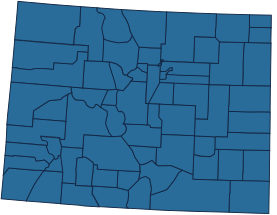
Colorado Inmate Records by Counties
Colorado's county jails typically hold offenders who are either serving short, relatively minor sentences (typically less than a year) or are awaiting trial. County jails are operated by local law enforcement agencies, usually the sheriff's offices. These county sheriff's offices are responsible for managing the custody and care of inmates in their respective jails. They also create and maintain records documenting essential information on these inmates, similar to how the CDOC keeps records on offenders in state prisons.
Interested members of the public can access these county inmate records by contacting the appropriate sheriff's office. Most county sheriff's offices also offer online search/lookup tools that can used to locate offenders incarcerated in their respective jails. Searches on these tools are usually done by name or booking number and return details on the inmate like their full name, age, physical description, offense(s), bond type and amount, warrant information, court dates, and expected release date. Note that the specific information obtainable from these search tools varies by county.
- Adams County
- Alamosa County
- Arapahoe County
- Archuleta County
- Baca County
- Bent County
- Boulder County
- Broomfield County
- Chaffee County
- Cheyenne County
- Clear Creek County
- Conejos County
- Costilla County
- Crowley County
- Custer County
- Delta County
- Denver County
- Dolores County
- Douglas County
- Eagle County
- El Paso County
- Elbert County
- Fremont County
- Garfield County
- Gilpin County
- Grand County
- Gunnison County
- Hinsdale County
- Huerfano County
- Jackson County
- Jefferson County
- Kiowa County
- Kit Carson County
- La Plata County
- Lake County
- Larimer County
- Las Animas County
- Lincoln County
- Logan County
- Mesa County
- Mineral County
- Moffat County
- Montezuma County
- Montrose County
- Morgan County
- Otero County
- Ouray County
- Park County
- Phillips County
- Pitkin County
- Prowers County
- Pueblo County
- Rio Blanco County
- Rio Grande County
- Routt County
- Saguache County
- San Juan County
- San Miguel County
- Sedgwick County
- Summit County
- Teller County
- Washington County
- Weld County
- Yuma County
Are Incarceration Records Public Information in Colorado?

Incarceration records are generally considered public information in Colorado per the Colorado Open Records Act (CORA). As such, interested members of the public can obtain records related to arrests, incarceration, and other offender or criminal justice-related information in the state. However, restrictions are placed on certain information, limiting their accessibility to authorized parties. These confidential records include juvenile offender records, inmate health/medical records, and sealed offender records.
Federal Prisons in Colorado
The U.S. federal prison system was officially established in 1891 and comprises facilities that manage and oversee individuals found guilty of committing federal crimes. These federal prisons are managed by the Bureau of Prisons. There are currently four such facilities in Colorado, which are listed below:
Note that the BOP's National Corrections Academy is also located in Aurora. However, this facility does not hold inmates; instead, it houses the bureau's Management and Specialty Training Center (MSTC) and the National Institute of Corrections' (NIC) Academy and Information Center. The MSTC provides specialized training for BOP staff, while the NIC's Academy and Information Center focuses on management and leadership training as well as building training capacity within corrections systems.
The BOP maintains an online inmate locator tool that interested parties can use to find inmates being housed in federal prisons located in Colorado. Searches via this tool can be conducted either by name or number (BOP register number, DCDC number, FBI number or INS number). Name searches can further be filtered by providing the inmate's middle name, race, age and/or sex. Note that only federal inmates incarcerated from 1982 to date can be located using this online tool.
| Prison Name | Location | Total Inmate Population | Security Level | Notes |
|---|---|---|---|---|
| Federal Correctional Institution (FCI), Englewood. | Littleton | 984 | Low Security | FCI Englewood is an all-male facility with an adjacent minimum security satellite camp and a detention center. The facility's satellite camp holds about 7% of its total inmate population. |
| Federal Correctional Institution (FCI), Florence. | Florence | 1,422 | Medium Security | FCI Florence is an all-male facility with an adjacent minimum security satellite camp that houses about 23% of its total inmate population. |
| U.S. Penitentiary (USP), Florence - ADMAX. | Florence | 355 | Maximum Security | USP Florence ADMAX is an all-male facility and is considered the BOP's highest security prison. |
| U.S. Penitentiary (USP), Florence - High. | Florence | 783 | High Security | USP Florence – High is an all-male facility. |
Frequently Asked Questions about Inmate Records
Here are answers to some frequently asked questions about finding inmate records in Colorado:
You can request copies of an inmate's departmental records by emailing the CDOC. Public record requests can also be directed to the department at:
1250 Academy Park Loop
Colorado Springs, CO 80910
Phone: 719-579-9580
You can look up inmates online in Colorado using the CDOC's Offender Search tool. Note that this tool only offers details on offenders in state prisons. Nonetheless, most county sheriff's offices offer inmate search tools (usually accessible via their official websites) that can be used to look up offenders in county jails.
You can obtain copies of old inmate records in Colorado by contacting the CDOC. The Colorado State Archives also maintains a repository for state penitentiary and reformatory records and provides an Archives Search database that can be used to access some of these records online.
You may be able to access an inmate's death records by contacting the facility where the inmate was housed or requesting a copy of their death record through the Colorado Department of Public Health and Environment. Be aware that, per Colorado law , death records in the state are considered confidential, meaning that they can only be released to eligible parties. These generally include individuals with a direct and tangible interest in the record, such as the decedent's immediate family.
Inmate information is typically updated on state and local online search tools in Colorado within 24 hours.
You can send money to an inmate in a CDOC facility via two main methods:
- Online or over the phone with a credit or debit card
- Depositing cash at designated locations across the country
The department currently utilizes three third-party service providers to facilitate payments into inmate accounts – JPay , Western Union , and GTL . Be aware that members of the public are not permitted to send money to multiple inmates within the CDOC; however, exemptions may be made for inmates with common immediate family members.
If you wish to send money to an offender in a county jail (or federal prison), it is recommended that you contact the facility directly to find out its specific methods and procedures for funding inmates' accounts.